

Building Competitive Advantage: A Strategic model for offshore development teams
- Gabriel Wansson

- Aug 25, 2025
- 7 min read

Gaining a competitive edge in New Zealand's tech sector now requires looking beyond local borders for talent. The constraints of local talent pools and escalating costs are prompting forward-thinking leaders to explore the vast potential of global tech talent.
However, simply outsourcing isn't a strategy. It requires a well-defined model to build a competitive advantage that truly propels your business forward.
This comprehensive guide is your strategic blueprint for navigating the complexities and maximising the benefits of offshore development. We will examine the key factors driving this trend, the critical decisions you'll face, and the actionable frameworks for success.
This guide equips you with the knowledge to make informed decisions. You will learn how to build a resilient, high-performing offshore team by understanding the tech landscape, identifying the right partners, establishing robust communication, and safeguarding your intellectual property.
Finally, we will explore the unique advantages that engaging with regions like Brazil can offer to New Zealand businesses seeking innovation and scalability.
The evolving landscape: Why offshore development is an Imperative
The forces reshaping the global economy are making offshore development not just an option, but increasingly a necessity for New Zealand businesses aiming for sustainable growth. Several converging trends are amplifying this imperative:
The persistent Tech Talent gap in NZ: Despite efforts to bolster the local tech industry, the demand for skilled developers continues to outstrip supply, leading to fierce competition and rising salaries.
Accelerated digital transformation: The pace of technological change is relentless, requiring businesses to rapidly scale their development capabilities to stay competitive and meet evolving customer demands.
The rise of remote work maturity: The normalisation of remote work has paved the way for greater acceptance and effectiveness of distributed teams, making geographical boundaries less of a barrier.
Global access to specialised skills: Offshore locations often boast deep expertise in niche technologies that may be difficult or expensive to find locally.
TechVantage Insight: We've observed a significant shift in mindset among New Zealand businesses. Initially driven primarily by cost considerations, the conversation has evolved to focus on strategic access to a wider talent pool and the ability to accelerate innovation cycles.
Our experience, as highlighted on our About Us, shows that companies leveraging global tech talent effectively are seeing not only cost efficiencies but also enhanced agility and faster time-to-market.
Defining your strategic offshore development model
Before embarking on offshore development, it's crucial to define the model that best aligns with your business objectives, project requirements, and risk tolerance. Several common models exist:
Outsourcing: Partnering with a third-party company offshore to handle specific projects or functions. This can be suitable for well-defined scopes and shorter-term needs.
Staff Augmentation (Outstaffing): Extending your existing in-house team with remote developers who work directly under your management. This offers greater control and integration.
Building your own offshore team (Captive Center): Establishing your own development center in another country. This provides the highest level of control but also requires significant investment and long-term commitment.
TechVantage Insight: Based on our work with New Zealand clients, the staff augmentation (outstaffing) model has gained significant traction.
It offers a sweet spot between cost-effectiveness and control, allowing businesses to scale their teams quickly with specialised skills while maintaining direct oversight of the development process.
Our services are specifically designed to facilitate this seamless integration of offshore talent into existing NZ-based teams. Understanding the nuances of outsourcing to NZ is key to choosing the right path.
Key Considerations for Successful Offshore Development in NZ
Navigating the complexities of offshore development requires careful consideration of several critical factors:
Talent identification and vetting: Establishing rigorous processes for identifying, screening, and hiring offshore developers with the right technical skills, cultural fit, and communication abilities.
Communication and collaboration: Implementing effective tools and protocols for seamless communication and collaboration across different time zones and cultural backgrounds.
Project management and governance: Adapting project management methodologies to suit distributed teams, ensuring clear roles, responsibilities, and accountability.
Legal and compliance: Addressing legal and regulatory requirements related to international contracts, data privacy, and intellectual property protection.
Cultural alignment: Fostering understanding and rapport between onshore and offshore team members to build trust and cohesion.
TechVantage Insight: We've learned that cultural alignment is often underestimated but plays a pivotal role in the success of offshore teams. Our focus on understanding and bridging the cultural nuances between New Zealand and Brazil is a key differentiator.
We invest in ensuring that our developers not only possess the technical expertise but also understand the communication styles and business etiquette prevalent in New Zealand, fostering stronger working relationships. This contributes significantly to the long-term success of the partnership.
Why Brazil? A Strategic Talent Hub for New Zealand's Offshore Needs
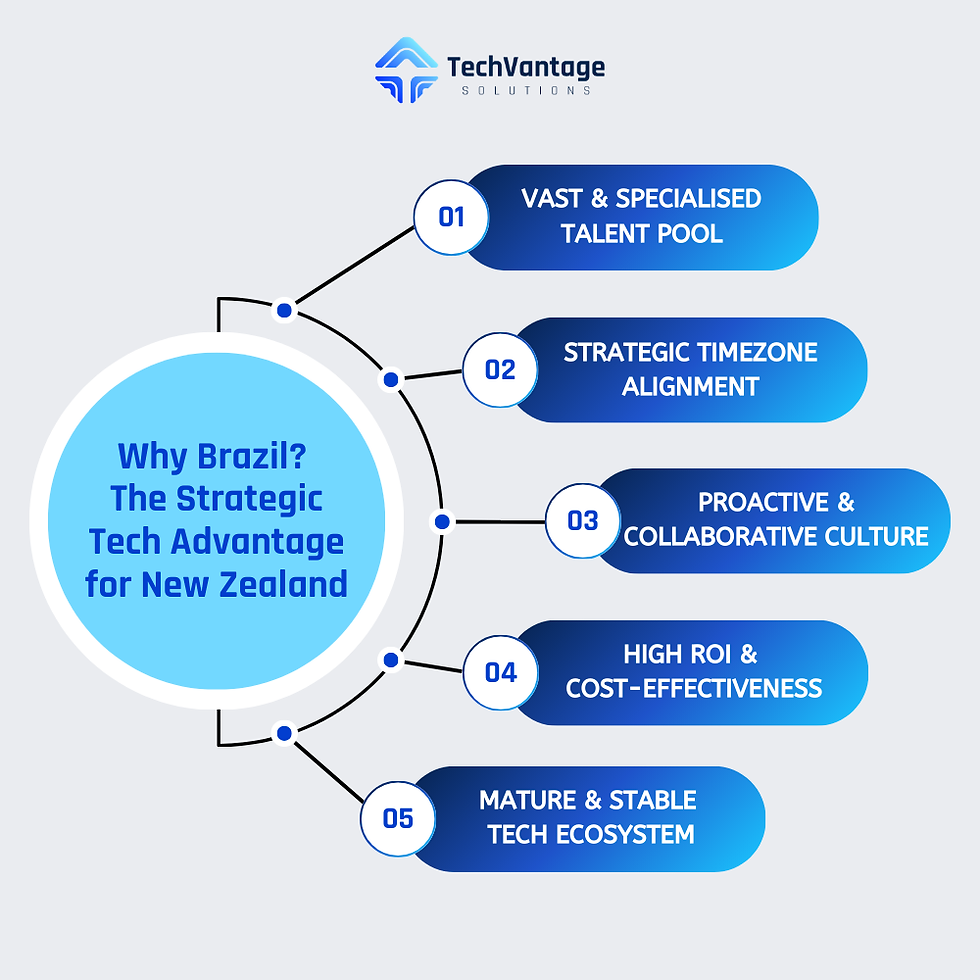
While various offshore destinations exist, Brazil has emerged as a compelling and strategic talent hub for New Zealand companies. The advantages go far beyond surface-level benefits and address core operational and innovative challenges.
Vast and specialised tech talent pool: With over 500,000 developers, Brazil offers not just scale but also deep expertise. The ecosystem has mature specialisations in high-demand areas like FinTech, SaaS platforms, and complex cloud architectures, which are directly relevant to the NZ market.
Strategic timezone alignment: The time zone overlap is more than a convenience; it enables a seamless 'follow-the-sun' development cycle. Your NZ team can hand off work to Brazil, allowing for continuous progress without the communication blackouts common with Asian or European teams.
Proactive and collaborative work culture: Brazilian developers are widely recognized for a proactive, problem-solving mindset. They don’t just execute tasks; they engage with the 'why' behind the work, contributing ideas and improvements that drive innovation, acting as true partners rather than just remote coders.
High ROI and cost-effectiveness: Brazil provides an exceptional cost-to-quality ratio. The investment gives you access to senior-level talent that would be significantly more expensive locally, delivering a higher return on investment (ROI) on your development budget.
Mature and stable tech ecosystem: Brazil's tech scene is supported by a strong university system and vibrant tech hubs like São Paulo and Florianópolis. This maturity ensures a stable supply of talent and a professional environment aligned with global best practices.
TechVantage Insight: Our deep roots in the Brazilian tech ecosystem provide New Zealand businesses with access to top-tier talent that aligns with their specific needs.
We act as your local partner in Brazil, ensuring smooth communication, cultural understanding, and adherence to quality standards. The strategic advantage of leveraging a Brazil dev team for your offshore development initiatives in NZ cannot be overstated.
Building a High-Performing Offshore Development Team: Best Practices
Creating a successful offshore development team requires a deliberate and strategic approach. Here are some key best practices:
Invest in robust Onboarding: Develop a comprehensive onboarding process that integrates offshore team members into your company culture, processes, and tools.
Establish clear communication channels and cadence: Utilize a variety of communication tools and establish regular communication schedules, including video conferencing, instant messaging, and project management platforms.
Foster a culture of trust and transparency: Be open and transparent in your communication, providing regular feedback and recognising contributions.
Implement rigorous code review and Quality Assurance Processes: Ensure code quality through regular reviews and robust testing methodologies.
Provide opportunities for collaboration and Team Building: Encourage interaction and relationship-building activities between onshore and offshore team members.
Regularly review and adapt your Offshore Strategy: The global landscape is constantly evolving, so it's essential to periodically review and refine your offshore development model.
TechVantage Insight: We've developed a proven methodology for building and managing high-performing offshore teams for our New Zealand clients.
This includes a strong emphasis on proactive communication, clear expectations, and regular performance reviews. Our goal is to ensure that your extended team in Brazil operates as a seamless and integrated part of your overall technology organisation.
Key Considerations for your offshore development strategy
Define Clear Objectives: What specific business outcomes are you hoping to achieve through offshore development?
Choose the Right Partner: Selecting a reputable and experienced offshore development partner is crucial for success.
Prioritise communication: Invest in tools and processes that facilitate effective communication across distances.
Focus on quality: Implement robust quality assurance measures to ensure high standards.
Build strong relationships: Foster trust and collaboration between your onshore and offshore teams.
Understand cultural differences: Be mindful of cultural nuances and adapt your communication and management styles accordingly.
Plan for long-term success: Offshore development is a strategic initiative that requires a long-term perspective.
Offshore development presents a significant opportunity for New Zealand businesses to build a lasting competitive advantage in 2025 and beyond. By strategically leveraging global talent pools, particularly the burgeoning tech ecosystem in Brazil, companies can overcome local talent shortages, accelerate innovation, and optimise costs.
However, success hinges on a well-defined strategy that encompasses careful planning, robust communication, a focus on quality, and a commitment to building strong, integrated teams. This pillar page serves as your foundation for understanding the key considerations and best practices for navigating this evolving landscape.
Ready to explore how offshore development with a focus on Brazilian talent can power your 2025 strategy? Contact us today for a consultation and let's discuss your specific needs and how Tech Vantage can help you build a high-performing global team.
Frequently Asked Questions (FAQ)
1. What are the primary benefits of offshore development for New Zealand companies? The main benefits include access to a larger talent pool, cost savings, the ability to scale teams quickly, and access to specialised skills that may not be readily available locally.
2. How can New Zealand companies ensure the quality of work from offshore developers? Implementing rigorous code review processes, establishing clear coding standards, utilising continuous integration and continuous delivery (CI/CD) pipelines, and maintaining open communication are crucial for ensuring quality.
3. Why is Brazil becoming a popular choice for offshore development? Brazil offers a strong combination of a large and skilled talent pool, a favorable time zone overlap with New Zealand, increasing English proficiency among developers, and a competitive cost structure.
4. How can TechVantage help New Zealand businesses with their offshore development needs? TechVantage specialises in connecting New Zealand businesses with top-tier software development talent in Brazil. We handle the talent sourcing, vetting, and onboarding processes, ensuring cultural alignment and providing ongoing support to facilitate seamless integration and project success.
5. What are the key legal considerations for engaging with offshore development teams? Key legal considerations include international contracts, intellectual property rights, data privacy regulations (such as GDPR if applicable to your customers), and employment laws in the offshore location.
6. How can New Zealand companies foster a strong working relationship with their offshore teams? Establishing clear communication channels, being transparent in your expectations and feedback, scheduling regular video calls, and even considering occasional in-person visits can help build strong relationships.
Join the conversation
We hope this guide provides valuable insights into building a competitive advantage through offshore development. What are your biggest questions or concerns when considering expanding your tech team with offshore talent?


Comments